Josh Bell delivered 96 RBIs and a 106 wRC+ for Minnesota, extending a four-year run of steady offense as first base options remain uncertain.
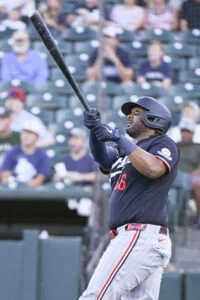
Josh Bell’s value is easy to underestimate. He rarely dominates headlines, but he keeps giving teams a dependable middle-of-the-order bat. His 2026 season with Minnesota extended a four-year stretch in which his wRC+ has stayed between 102 and 106. That’s a narrow range, and it describes a player whose production has been steady even as his teams have changed. At a position where this winter’s alternatives look uneven, predictability has real appeal.
A reliable season in Minnesota
The Twins signed Bell to a one-year, $7MM contract last winter after he hit 22 home runs as Washington’s primary designated hitter. Minnesota used him in a similar role, and he responded with a .255/.319/.419 line over 631 plate appearances. His 96 RBIs were his most since 2019 and ranked fifth in the American League. Those figures don’t make him a star, but they show how a regular lineup presence can produce meaningful value without a standout power season.
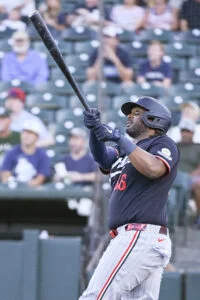
Bell’s 106 wRC+ matched his 2025 mark. That’s a quieter profile than his 2019 season, when he hit 37 home runs and made the All-Star team, or 2022, when he won a Silver Slugger as a designated hitter. Those peaks remain part of his résumé, but they aren’t the best guide to what a club should expect now. The more useful signal is that he has stayed just above league average for four years, across six teams in the past six seasons, after spending his first five years in Pittsburgh.
Durability strengthens the case. Bell has played at least 140 games in every full season of his career, excluding his July promotion as a rookie in 2016 and the shortened 2020 campaign. He hasn’t landed on the injured list since 2021. For a team filling a daily first base or DH spot, availability matters: a capable hitter who remains in the lineup can be easier to plan around than a more volatile option.
That consistency has limits. A 106 wRC+ is a modest advantage at a position where clubs often want substantial power, and Bell’s recent production doesn’t promise a return to his 2019 level. Still, a steady bat over a full season has practical value. The numbers here are underwhelming if the expectation is a middle-of-the-order force; they’re more useful if the goal is to avoid a hole in the lineup.
Consistency in a crowded market
A slightly above-average bat may not be the ideal return from a first baseman or designated hitter. Still, last offseason’s comparable options offered little assurance. Marcell Ozuna, Rhys Hoskins and Carlos Santana also signed one-year major league deals. Nathaniel Lowe, Andrew McCutchen and Eloy Jimenez took minor league contracts and reached the majors; Lowe was productive for Cincinnati and is contributing for Cleveland in the postseason, while the others struggled. Ty France was the clear standout among the alternatives.
That group illustrates the risk built into this market. Clubs can find a recognizable name or a player with a stronger peak, but neither guarantees a productive season. Similar free-agent pools often force teams to weigh a higher ceiling against a less predictable floor. Bell’s appeal is comparatively plain: he has recently delivered a narrow band of above-average offense and has stayed available. Here's the thing: for a roster that needs a regular, that can be a more useful bet than a splashier profile with less dependable recent results.
Bell could return to the open market if he and Minnesota don’t exercise their $10MM mutual option. Ozuna, Hoskins and Lowe may also be available, alongside George Springer, Joc Pederson, Jorge Soler and Miguel Andujar. It’s a broad list, but not an especially reassuring one for clubs seeking dependable production at first base or DH. The range of names gives teams choices; it doesn’t erase the uncertainty over which players can sustain their output.
Bell’s next signing probably won’t draw much attention. That’s fitting, but it may obscure the practical value of what he offers: another durable season and a steady bat in the middle of the lineup. If you’re working in this space, the key question isn’t whether Bell can recreate his best season; it’s whether his recent level, at the right cost and role, fits the roster. This is more significant than it looks when a club needs everyday at-bats and has few dependable alternatives. And yet. His floor is useful, not spectacular.
What Bell’s market says about roster needs
The market for first basemen and designated hitters can leave teams choosing between players with proven peaks and players who offer a steadier recent baseline. Bell belongs to the second group. His history suggests that a club can plan around regular availability and offense close to league average, though that profile still leaves room for disappointment if the lineup needs more power than he supplies.
(And this is the part most people overlook.) The value of a signing depends on the job a team needs filled. A club seeking a centerpiece will likely look elsewhere; a club seeking a durable contributor may see Bell’s recent record as a sensible fit. His next contract won’t settle the broader question of how much consistency is worth in this market. It will show whether teams are willing to pay for a reliable role player when stronger guarantees are scarce.
Photos courtesy of Matt Marton and Ed Szczepanski, Imagn Images
Discussion
Sign in to join the discussion.