Bryan Baker has evolved into one of the top closers in the American League after refining his pitching strategy with the Tampa Bay Rays.
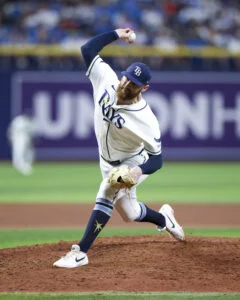
The Tampa Bay Rays entered the 2026 season facing a rare challenge in the closer role following the departure of Pete Fairbanks, who had established himself as a key late-inning pitcher since 2023. Fairbanks's three consecutive years leading the team in saves left a significant gap when he signed with the Marlins, prompting a deep dive into candidates for the closer position.
Close Competition for the Closer Role
Among the contenders, Bryan Baker initially ranked behind pitchers like Edwin Uceta and Griffin Jax, as well as receiving a nod of consideration along with Garrett Cleavinger. Yet, Baker's history revealed potential. Acquired in a trade with the Baltimore Orioles mid-2025, Baker had shown promise as a middle reliever and emerged as a surprise All-Star with the Rays. He led the league alongside Cade Smith of the Guardians, finishing the regular season with 41 saves, a 1.44 ERA over 65 innings, and successful performances in the playoffs.
This isn’t just about numbers; Baker’s journey reflects a broader narrative of adaptation and growth within the Rays organization. Tampa Bay has a reputation for identifying talent in unexpected places, and Baker fits this mold perfectly. His emergence as a key figure at such a vital position offers a glimpse into the team's strategic approach to player development. With Fairbanks gone, a significant responsibility fell on Baker, not only to fill the statistical void left by his predecessor but also to shoulder the psychological weight of the closer role.
A Rocky Start
Baker's journey in the majors began with the Toronto Blue Jays in 2021, leading to a stint with Baltimore where he spent three seasons refining his skills but failed to stand out significantly until his move to Tampa Bay. The transition wasn't smooth initially, as he struggled to maintain his strikeout rate and posted an ERA over 4.75 in his first season with the Rays, leading to questions about his viability as a closer. The pressure was on. Could he shake off the past and rise to the occasion? Many would argue that, under such pressure, many pitchers falter.
Strategic Changes: The Turning Point
The turning point came when Tampa Bay's coaching staff encouraged him to alter his pitching mix. Notably, they pushed him to increase his reliance on his changeup, which became his most effective pitch. His usage of the changeup leapt from 22.2% last season with the Orioles to 34.2% in his first season with Tampa Bay, and it has now escalated to an impressive 43.8% this year. This strategic shift resulted in a reduction of his slider usage to a mere 3.3%—his lowest rate to date, having previously relied on the pitch heavily.
This isn’t merely a story of pitch selection; it speaks to the Rays' emphasis on maximizing player potential. In a league where pitching talent is abundant, figuring out how to stand out can be the difference between a fleeting career and lasting success. It’s also important to acknowledge that adjusting pitch selection can feel overwhelming for some pitchers, but for Baker, it opened new avenues. What Baker’s coaching staff recognized is that his changeup was not just a secondary option; it was, in fact, a primary weapon against major league hitters. This insight aligns with shifts in modern baseball strategies, where reliance on one high-quality pitch can often lead to greater success than a diverse but less effective repertoire.
Data-Driven Performance
While it may seem straightforward for pitchers to throw their better pitches more often, Baker’s changeup has delivered significant results. Since becoming a full-time major leaguer, this pitch has accrued a 16 Run Value, effectively limiting batters to a sub-.200 average against it in most seasons. Prioritizing the changeup not only plays to his strengths but also mitigates risks associated with his previously exposed slider, which was responsible for nearly half the home runs he allowed in 2025.
These statistics tell a compelling story: the data suggests that maintaining a strong focus on one effective pitch can dramatically influence a pitcher’s success. Managers don't often detail such analytical findings in post-game interviews, but they offer critical insight into pitching strategies. Meanwhile, the league is witnessing more pitchers crafting their careers around signature pitches, an approach reminiscent of past star players who thrived on a similar methodology.
Team Philosophy on Pitching
Interesting observations from manager Kevin Cash reflect the Rays’ philosophy on pitching adjustments. Cash highlighted the strategic mindset that emphasizes leveraging a pitcher’s strengths rather than imposing drastic changes—an approach conducive to Baker’s development. Like the earlier transformation seen with Freddy Peralta, modifications in how Baker utilized his pitches have led to him becoming an integral asset to the team.
This validation of Baker’s adjustment was significant for the entire pitching staff. If you’re working in this space, you'd likely agree that instilling confidence in players can be just as important as statistics. Engagement with players, especially on what works for them and what doesn’t, fosters a culture of openness that can yield surprising results.
Future Outlook and Implications
As Baker threw more changeups, especially against right-handed hitters, he demonstrated efficiency, achieving a mere .549 OPS against righties this year compared to .774 the previous season. This enhanced performance aligns with Tampa Bay’s modern approach of regularly employing changeups in right-on-right matchups, showcasing this growing trend in contemporary pitching strategies.
Looking ahead, the Rays hold team control over Baker for two more seasons, but projecting his future remains complex. His remarkable .203 batting average on balls in play (BABIP) and an 88% left-on-base rate are almost certainly unsustainable, suggesting that while his stellar 2.00 ERA may not be replicated, his refined approach positions him as a formidable closer. Even with potential regression, Baker has solidified his reputation as one of the top closers in the American League—an asset crucial to the Rays' continued playoff ambitions.
What this means for you, as someone following the Rays or the broader baseball scene, is clear: the approach toward pitching is shifting. The Rays' philosophy emphasizes evolving player strengths, and they’re willing to turn the seemingly ordinary into extraordinary. With Baker at the helm of the closer role, the Rays not only fill a vacancy but reinforce a broader strategy that could resonate through their pitching staff for seasons to come.
Photos courtesy of Brad Penner and Nathan Ray Seebeck, Imagn Images
Discussion
Sign in to join the discussion.